


LCRA, City of Lampasas award $24,789 grant to restore historic Fourth Street Church
Lampasas Heritage Foundation will restore storm-damaged landmark for use as a community center
Nov. 20, 2026
- LCRA and the City of Lampasas award a $24,789 grant to the Lampasas Heritage Foundation to support restoration of the historic Fourth Street Church.
- The project will help preserve a culturally significant building damaged by a 2019 windstorm and prepare it for a new purpose as an accessible community center.
- The grant is one of 43 being awarded through LCRA’s Community Grants program through December. LCRA will accept applications in January for the next round of grants.
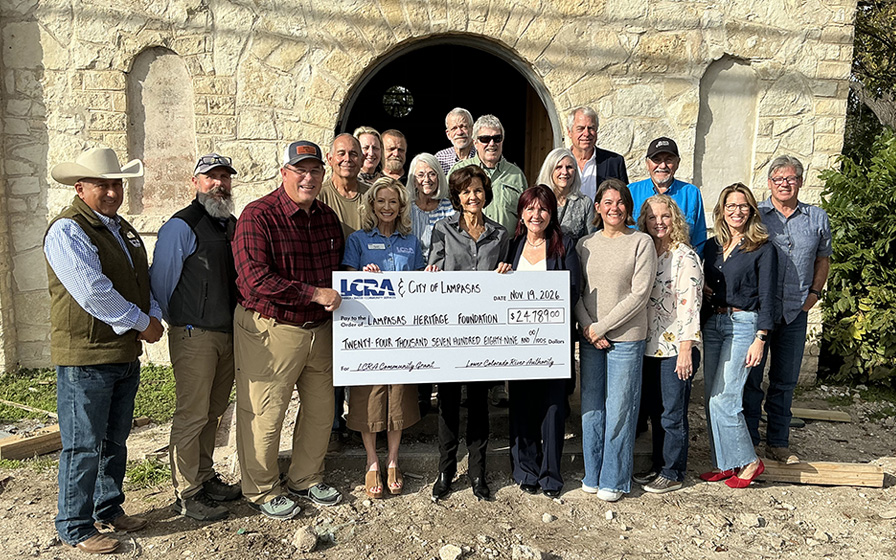
LAMPASAS, Texas – A historic Lampasas church severely damaged by a 2019 windstorm will continue its transformation into a future community center, thanks to a $24,789 grant from the Lower Colorado River Authority and the City of Lampasas.
The LCRA Community Grant, along with $52,140 in matching funds from the Lampasas Heritage Foundation, will support the completion of Phase I of the restoration of the Fourth Street Church. The work includes major structural and architectural improvements, including completion of the exterior walls, windows, doors, façade and bell tower, a wheelchair-accessible ramp, ceilings, flooring and preparation for new restrooms.
“You can’t put a price tag on history or community,” said Deborah Reynolds, president of the Lampasas Heritage Foundation. “Those things are priceless. After the storm, the church had become a pile of rubble with two collapsed walls, but I thought about all the stories those walls had witnessed. The love, the heartache, the weddings and funerals of generations of families. Once you bring in a bulldozer, all of that history is gone forever. Saving this building means saving those stories and honoring the people who came before us.”
The church was constructed in the 1940s as St. Christopher’s Catholic Church for Lampasas’ Hispanic community. Following the integration of St. Mary’s Catholic Church in the 1950s, the building was sold and used as an automotive body shop before becoming St. Paul’s African Methodist Episcopal Church in 1964. It served as a religious and social center for the African American community of Lampasas for decades before eventually closing.
After a severe windstorm caused the church’s roof and several walls to collapse in 2019, the building faced potential demolition. The Lampasas Heritage Foundation was established to lead efforts to preserve the property. Since then, restoration work has included rebuilding damaged walls and the bell tower, installing a steel support frame and adding a new metal roof. The project aims to preserve the church’s original Spanish mission-style architecture, including historically appropriate windows and doors.
In 2023, Preservation Texas included the Fourth Street Church among four endangered historic resources collectively identified as the Historic Resources of East Lampasas.
Once the full restoration is complete, the former church will serve as a nonreligious community center for public meetings, town halls, educational programs, historical presentations, cultural events, performances and other gatherings. Located beside the Sulphur Creek hike-and-bike trail and within walking distance of historic downtown Lampasas, the facility will be available to residents and community organizations throughout the area.
“This has truly been a labor of love, and it’s an honor to help bring this piece of Lampasas history back to life,” Reynolds said. “Our hope is that this building will be a gift back to the community, a place where people can come together, build friendships and create new memories. It has already lived through so many chapters, and now we have the opportunity to give it another one. We’re incredibly grateful to LCRA and the City of Lampasas for supporting this work and helping us take the next step toward making that vision a reality.”
The grant will help the foundation complete the first phase of restoration, including critical structural and architectural improvements needed to secure the historic building and prepare it for future public use.
This is one of 43 grants awarded recently through LCRA Community Grants. These grants are awarded twice a year as part of LCRA’s effort to give back to communities in its wholesale electric, water and transmission service areas.
Applications for the next round of grants will be accepted in January. More information is available at www.lcra.org/grants.
Contact Info
About LCRA
The Lower Colorado River Authority serves communities across Texas by managing the lower Colorado River, generating and transmitting wholesale electric power, providing clean water supplies, operating telecommunications infrastructure, and owning parks for outdoor recreation. LCRA delivers power, water and infrastructure that support the region’s growth and quality of life. LCRA and its employees are committed to fulfilling our mission to enhance the quality of life of the Texans we serve through water stewardship, energy and community service. Created by the Texas Legislature in 1934, LCRA receives no state appropriations.
Social Media